Showing posts with label Cellini. Show all posts

Wednesday, September 10, 2014

Narcissus object of desire

Everyone has heard about this myth, at least one of the many versions. Most of the versions have similar elements, like the extreme beauty of Narcissus, and his death.

The Ovide's Metamorphoses tells the story of Narcissus and Echo, ''a mountain nymph, who saw him, fell deeply in love, and followed him. Narcissus sensed he was being followed and shouted "Who's there?". Echo repeated "Who's there?". She eventually revealed her identity and attempted to embrace him. He stepped away and told her to leave him alone. She was heartbroken and spent the rest of her life in lonely glens until nothing but an echo sound remained of her. Nemesis, the goddess of revenge, learned of this story and decided to punish Narcissus. She lured him to a pool where he saw his own reflection. He didn't realize it was only an image and fell in love with it. He eventually realized that his love could not be addressed and committed suicide.''''
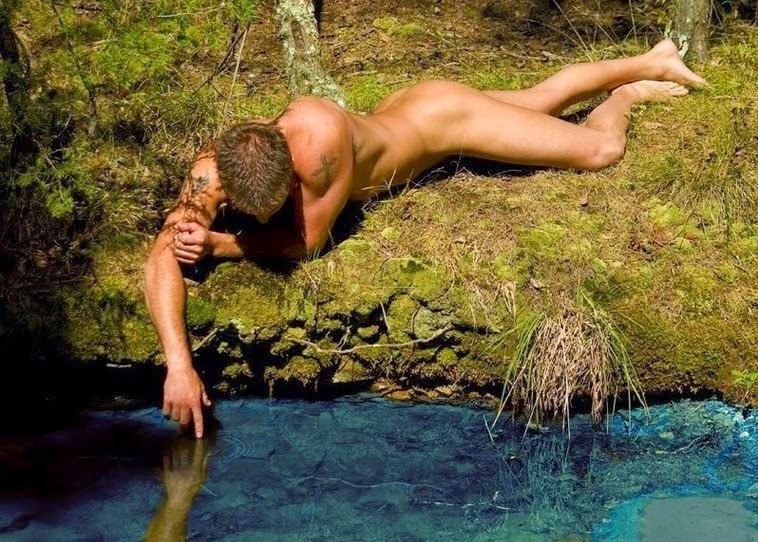
The male version of it, ie a young man instead of a woman who fells in love with Narcissus, is the one by Conon (who lived at same time as Ovide). ''Aminias indeed fell in love with Narcissus, who had already spurned his male suitors. Narcissus also spurned him and gave him a sword. Aminias committed suicide at Narcissus's doorstep. He had prayed to the gods to give Narcissus a lesson for all the pain he provoked. Narcissus walked by a pool of water and decided to drink some. He saw his reflection, became entranced by it, and killed himself because he could not have his object of desire.''

A few sculptures have been created from this myth. My preferred one is sculpted by Paul Dubois, in 1866 currently displayed at the Orsay Museum in Paris.
Paul Dubois marble sculpture 'Narcissus' 1866 (detail)

Drawing - study- by Paul Dubois for his Narcissus sculpture.
Same sculpture - back
 Other sculptures are from Jean-Pierre Cortot, in the Musée des Beaux Arts of Angers, France.


From Ernest Eugène Hiolle (1834-1886) - Fine Arts Museum of Valenciennes, France.
Narcissus by Ernest Eugène Hiolle

 From Benvenuto Cellini, displayed at the Bargello, Firenze, Italy.
Benvenuto Cellini (1500-1571)-  Narcissus sculpture - 1548

And below is a curiosity, a hand mirror made by Henri Nock, in 1897, with silver, enamel, precious stones, showing a little sculpture of Narcissus looking into the mirror.


In terms of more recent or contemporary sculptures of Narcissus, here are also two examples.
First by Glyn Warren Philpot (1884-1937), British artist more known for his portraits, elected to the Royal Academy in 1923, but who suffered later during his career while doing controversial art pieces for his time. This work was cast posthumously by the artist's niece.
Glyn Philpot - Echo and Narcissus - Bronze 56cm

 And this one, made by Karl-Jean Longuet (1904-1981). He studied in Paris, met Brancusi and visited his workshop in 1949, then started to create more abstract figures like this Narcissus.
Karl Jean Longuet - Narcissus


Two videos :
- Video about Narcissus myth

- And below is a video in English about the myth of Narcissus as a gay tragedy


Now, if you read French, is a more detailed story that includes many aspects of this myth gathered together. Source : the world history of male love

Au dire de tout le monde Narcisse était le plus beau garçon de toute la Grèce. Même bébé il attisait les braises de la passion de toutes les femmes qui le gardaient, les jeunes comme les vieilles. Avant son seizième anniversaire il était déjà l'objet de chaque fantasme féminin sur des kilomètres à la ronde et aussi de plus de quelques fantasmes masculins. Ni les filles ni les garçons ne l’intéressaient pourtant le moins du monde.


Echo était une nymphe de la montagne qui avait une fois servi Zeus en entraînant Héra dans des bavardages insensés chaque fois qu’elle était proche de découvrir que le Dieu de la foudre compromettait les voeux de son mariage. Le bavardage de Echo donnait aux invitées de Zeus suffisamment de temps pour faire leur sortie. Quand Héra découvrit le caprice de déesse loquace, elle éclata de rage "Désormais cette langue malfaisante sera silencieuse ! Sauf quand on te parlera, tu ne parleras pas et même alors tu n’émettras que de brefs bruits."


Ainsi quand Echo surprit Narcisse un matin comme le jeune homme luttait avec un cerf qu’il venait de prendre dans son filet, elle ne put que regarder sans parler. Et regarder fut ce qu’elle fit. Même parmi les dieux immortels elle n'avait jamais vu son pareil. Un désir brûlant courut dans ses veines. Comme elle désirait séduire le beau jeune homme avec des mots mielleux, mais elle bougeait ses lèvres en vain.


Narcisse sentit ses yeux sur lui. "Qui est là ?" appela-t-il.
-"Là," répondit Echo, qui pouvait seulement répéter ce qui lui était dit.
- "Laissez-moi vous voir" dit le garçon.
- "Vous voir," dit Echo.

Momentanément intrigué, Narcisse cria alors, "Comment vous appelez-vous ?"

-"Vous appelez," répondit la nymphe. Et, incapable de contenir son ardeur, elle s’échappa de sa cachette et se jeta, chaude et haletante, sur le bel adolescent. Commençant à être habitué à un tel comportement, Narcisse se libéra rapidement de son étreinte et s’enfuit en toute hâte au plus profond de la forêt, laissant ses filets derrière lui.

Echo le poursuivit, essayant de crier les mots qui apaiseraient ses craintes, le désarmeraient, mais aucun son ne vint. Le jeune homme disparut bientôt de sa vue. Pendant des semaines la nymphe erra dans la forêt à la recherche de son bien-aimé, dormant peu, ne mangeant rien. Elle s’amincissait tant qu’il ne resta bientôt d'elle rien qu’un oeil puisse discerner. A ce jour elle erre dans les montagnes du monde entier, cherchant toujours Narcisse. Les canyons rocailleux et les vallées profondes sont sa demeure. On peut l’appeler, et si elle est là, elle répondra mais seulement avec les mots qu’on lui aura dits. Par décret de Héra elle ne peut en prononcer aucun autre.

Un après-midi, à un mois de sa fuite devant Echo, dans un bois isolé haut sur le mont Hélicon Narcisse tomba à genoux, épuisé de chasser et d’être chassé. Devant lui se trouvait une pièce d’eau claire et profonde dont la surface vitreuse capturait la lumière qui traversait les arbres au-dessus pour devenir un miroir parfait. Ceci, bien sûr, se passait bien avant que les miroirs comme nous les connaissons aient été inventés.

Narcisse avait vu son ombre plusieurs fois mais jamais son reflet. Ainsi, quand il se pencha appuyé sur ses mains et ses genoux et regarda dans la mare, il fut surpris par l'image de beauté sans égale qui le regardait. Aucun visage qu’il ait vu ne ressemblait à celui qu’il étudiait à présent. Pour la première fois de sa vie il tombait amoureux.

Echo and Narcissus; John Waterhouse, 1903; Walker Art Gallery at Liverpool

Il baissa son visage plus près pour embrasser le jeune homme et tendit les bras dans la mare pour l’embrasser. Ses lèvres et ses bras trouvèrent seulement de l’eau. Bien qu'il se retira rapidement, l'effet de miroir fut un moment détruit par des ondulations dans l'eau. Pensant que son bien-aimé l’avait fui comme il avait lui-même l’habitude de le faire, Narcisse se mit à pleurer. Bientôt, cependant, l'eau s’éclaircit, et le beau visage apparut à nouveau. "Ne me laisse pas, ô beau jeune homme," supplia-t-il. "Reste, mon amour."

A nouveau Narcisse baissa la main pour toucher la forme dans l'eau ; à nouveau l'image s’estompa quand sa main cassa la surface. Presque convaincu qu’il avait cette fois pour toujours perdu son vrai amour, il s’arracha les cheveux et se griffa la gorge de ses ongles. Quand il se fut apaisé et que les eaux se furent à nouveau éclaircies, l'image de son amour réapparut, meurtrie et échevelée. La vue le peina, et il pleura.

Le chariot d’Hélios finissait sa course à travers le ciel, la nuit grise envahissait la forêt, mais Narcisse ne bougea pas. Rien ne lui importait plus que sauver le jeune homme insaisissable dans la mare. La première lueur de l’aube le trouva à regarder attentivement dans les claires profondeurs de l’eau. Le visage qui apparu lentement était hagard et angoissé. Il tendit la main dans l'eau pour caresser cette joue maintenant si chère à lui, et ses frustrations du jour précédent se renouvelèrent.

"Je t’aime ! Je t’aime !", cria-t-il un millier de fois dans la mare. Le visage, comme Echo, bougeait la bouche mais n’émettait aucun son. Malgré lui, incapable de quitter le bord de la mare, Narcisse finit par mourir là, sa contenance jadis si belle maintenant tordue et grotesque. Les nymphes de la montagne le trouvèrent et l'auraient enterré ; mais comme elles le préparaient pour les funérailles, son corps disparut, et où il se trouvait éclôt une fleur aux pétales d'or teintés de blanc.

Wednesday, February 12, 2014

Ganymede, the cutest young man on Earth (1) sculptures

Ganymede was known to be the most handsome young man on Earth. Several stories circulate about Ganymede myth, they usually converge on the fact he was very handsome, like a Young God, and Zeus felt in love with him the day he saw him playing on the fields of Troy and Mount Ida.


Sculpture from Ernst Seger, Germany - Hearst Estate - San Simeon - California.
Picture from Saint Plan


Sculpture by Thorvaldsen -Minneapolis Institute of Arts
Thorvaldsen sculpture - Copenhagen
                    
Reportedly Zeus transformed himself into an eagle, and grabbed the boy. The two arrived fast to Mount Olympus. ''The eagle folded his wings, shook himself once and turned back into a god. He took Ganymede to bed and then appointed him cup bearer.''

Sculpture from Benvenuto Cellini - Florence - Italy
Sculpture by Adamo Tadolini 1788 -1868 in Hermitage Museum - St Petersburg.
Photo by Ayir Heklai.
Same - detail
                                 
Sculpture by Pierre Julien 1731-1804 Louvre Museum - Paris.
Picture by K. Ignatidis


Ganymede's father, Tros, cried endless tears after the loss of his son, not knowing what happened. Zeus was moved by his pain, and sent down Hermes as messenger, who let Tros know his boy was now among the gods, immortal and forever young. Zeus gave Tros in exchange for his son two beautiful and strong white horses able to walk on water, the very same that carry the immortals. Tros’ heart was filled with joy and he drove his new horses as fast as the wind.

 
''Zeus, grateful for Ganymede’s love, made a place for him among the stars as Aquarius – the Water Bearer. There he still stands, smiling, pouring nectar and shielded to this day by the wing of the Eagle constellation.''

Burkli Platz - Zurich - Switzerland. Hermann Hubacher
 
Ganymede's sculptures

Several sculptures were made to glorify or illustrate the love between Zeus and Ganymede, or Ganymede's rapt, by famous sculptors like Michelangelo or Cellini. 

Benvenuto Cellini - Museo Nazionale del Bargello, Florence - Italy.
 
Benvenuto Cellini - Museo Nazionale del Bargello, Florence - Italy
 
Hermitage Museum - St Petersburg

In Italy, some sculptures can be seen at the Vatican museum, at the Uffizzi in Florence, and at the archeological museum of Naples. Other sculptures are in various Europe's museums, like St Petersburg Hermitage, or Copenhagen, or Louvre in Paris.

At the Archeological Museum of Naples
Found in the remains of a villa Via Prenestina - Rome - Italy 
 
Other art media

Ganymede is also represented on other media by famous ancient artists (Le Titien, Rembrandt, Michelangelo, Rubens) as well as contemporary (Pierre & Gilles and others) and this will be the subject of another post. In litterature, the myth is mentioned by Virgile, Plato, Ovide, and more recently by Goethe, Cavafy. 

An extensive collection of Ganymede's portraits, drawings, engravings, and sculptures can be seen here.   http://gayekfansi.blogspot.com/2011/08/blog-post_31.html?zx=11813a29d6afba63

Wednesday, January 29, 2014

Perseus by Benvenuto Cellini - the sculpting technique (2)


The bronze casting

Before carrying out the casting, it is necessary to bury the mold. As it is so high, and as the molten metal is to be poured from the top so that it reaches by gravity the lower parts of the statue, there is no alternative but to bury the mold at the foot of the kiln where the metal will be melted. In addition, it provides a protection against potential mold burst when the two tons of metal will be poured. And it also contributes to a slower cooling of the metal, as the mold is uniformly isolated, so it improves the chances for the metal to reach the most remote areas.
Metal poured into a mold - Chammings sculptor workshop
 It took six months to bury the mold and build the huge furnace where the metal was melted. With  picks and shovels, to a depth of about four meters, the pit is ready. The mold is then lowered using a winch and a massive scaffolding. It was critical to avoid any shock to the mold as a crack would have forced to start over. After several attempts, Cellini, with its workers and with strong ropes, succeeds to position the mold in the bottom of the pit.The furnace itself was manufactured with the utmost care, taking into account the choice of bricks, their disposal, the general shape of the furnace, the volume needed to accommodate the entire metal, the necessary openings for pouring and combustion of the metal and the opening hole to pour the metal into the mold.
Cosme 1 de Medicis, portrait by Pontormo - 1518
Five years had passed since Cosimo had commissioned Cellini 's Perseus . The tension was high with the Duke. Cellini was the subject of a conspiracy with his project that all qualified as foolish and undoable. Nevertheless, Cellini resists, his glory and honor is at stake if it fails, he would be banished from Florence and could no longer perform his job.The day of casting, the mold is buried with a mixture of soil and sand. The openings in the mold are extended with stoneware pipes so that they are not obstructed by the soil and allow the evacuation of air and gas. It is important to proceed with the casting as soon as possible before the moisture attack the mold. Ingots of copper, brass and tin (two tons in total) are arranged in the furnace. Cellini's entire team is at work .


The fire is lit and the metal begins to melt and boil. But the oven gives off so much heat that the thatched roof starts to burn. The rain, which began to fall, helps to contain the fire, however, it threatens to penetrate into the mold, which must be avoided at all costs. A battle against the fire starts immediately.

After several hours of hard work, and Cellini close to exhaustion, the molten bronze began to coagulate, making it impossible to flow. Cellini throws into the furnace oak logs that generate more heat. He managed to break the bronze crust that formed on the surface, but the overheated oven cover explodes and revives the fire. They need to cast as rapidly as possible. The metal is too thick and does not flow fast enough. Cellini then added tin and finally the mold begins to fill. All the metal contained in the furnace is used. The mold is completely filled. The cast is completed.

After two days of cooling, the mold is cleread from the soil around it, and taken out from the pit with the same winch that was used to take him down. Cellini begins to break the mold to reveal the statue. As Cellini had expected, only the right foot of Perseus - the most remote area from the opening hole - had not received enough metal. The following months will be devoted to the completion of the foot, to cast the sword and helmet wings and sandals, to fix them to the statue, to carve the damaged details from the melting and then the surface polishing.

The Base

Cellini had planned to complete his work with a majestic marble base three meters high. He set four niches of about one meter on each side of the rectangular block. In the niches, he created and displayed statues of Mercury, Minerva, Jupiter and Danae with her son Perseus.


The block itself is carved with various motifs like shaped garlands, ram heads, shells and goddesses' busts. The finishing touch is a bronze bas-relief depicting Andromeda liberation by Perseus, on the stand base.


Unveiling

It took another five years to complete the base and install it under the arcade of the Loggia dei Lanzi. The transport of the three heavy sections, Medusa, Perseus and the base is delicate and difficult. It also attracts curiosity. Cellini resists the pressure to disclose his work until all pieces are linked together. The tarp covering the work is finally withdrawn on April 27, 1554, nine years after the order. Without ceremony, Perseus appears to the crowd of onlookers. It is triumph. Cosimo I even expressed his satisfaction at Cellini.

However, the payment for the statue is a cause of further tension between the two men, because of poorly conducted negotiations. Cellini will never get any more order of that importance. Now considered a genuine masterpiece and a technical major achievement, Perseus always throne to its original location. The work has been the subject of a restoration in 2000, for the 500th birthday of Cellini.

Wednesday, January 22, 2014

Perseus by Benvenuto Cellini - the sculpting technique (1)


This post will be a little longer than usual, as it tends to describe (adapted from French Wikipédia) the whole process to create this stunning Perseus sculpture.

The thinking process before the sculpture

Because of the many fragile parts (sandals' wings, sword, raised arm with Medusa head, etc.) to be sculpted in marble, Cellini decided to do a bronze sculpture, despite the planned height of 6 meters.
To facilitate the making, and also for aestethic reasons (as the proportions for a 6 meters statue would have been too disparate) he divides in 2 the planned height. From right foot to Medusa head, the final height will be 3.20 meters, in addition to the 3 meters base to be sculpted.

Cellini is willing to cast the statue in one unique piece, even though it is a very imposing height, as he wants to avoid the problems encountered by Donatello and his Judith sculpture. That sculpture was made with 11 different parts, melted separately then welded. But doing this it was showing variations in colors, in thicckness, and the weldings were too visible. Cellini did not wanted that at all.

Also, as the Perseus was planned to be located below one arcade (see picture below), and not leaning against a wall, Cellini wanted the sculpture to be beautiful and full of harmony from all faces. Eventually, he wanted to sculpt the 4 faces from the base with bas reliefs, to develop and enrich the myth.

 
Steps

Cellini will first start with the Medusa head, then Perseus, then the base. The challenge is enormous, because the technique to mold a bronze statue so high was lost since Antiquity.
To succeed to cast the statue in only one piece, Cellini will use the lost wax technique, in which the sculpture is made in wax, on a mold in clay. The was is then covered with clay. Then the wax is melted and lost. Bronze is then cated between the two layers of clay. Once the bronze is cold,  refroidi, the outside mold is broken to reveal the sculpture.

Medusa

 
Before to start with Medusa bronze, Cellini does some experiences, like with the clay to be used for the molds. He does a Julius Cesar bust, which confirms his choices. Then, to be fully sure about his technique, and to please the Florence Duke, he does a Cosme Ier bust.

Now that he is 100% reassured on the clay quality, he starts the Medusa cast. As she has to stand on a small surface,  he decides to display her body on a shield and on a cushion.The cushion reminds the bed on which Medusa was surprised by Perseus while she was sleeping.

The shield evokes the one that Athéna gave to Perseus to allow him to be close from Medusea without being transformed into stone. Legs are folded in a unsual angle, while the left arm grips one ankle, and the other arm lays lifeless along the base. From the beheaded neck, a river of blood leaks, quite a strong vision for that time.

It takes Cellini two years before to unmold Medusa. The result is impeccable. It earned him the esteem but also jealousy. Cellini must even defend his project with the Duke, who is very impatient and has doubt, like the others, about the ability to cast the imposing bronze Perseus. Cellini succeeds to persuade him with lots of technical arguments, but the relationship between the two men remains fragile.


Perseus

Despite the tension and fear of failure, Cellini starts the making of Perseus. Because of its size, the statue must be empty, otherwise the weight of the bronze would make it impossible to move. To do this, it takes a special mold.

Cellini first solidifies the mold with iron bars, to support the wire mesh that draws the first contours of the statue. It then prepares the clay that will cover the trellis. This clay, taken near Florence, has been carefully chosen and prepared first with pieces of sheets. After mixing them until a smooth paste, Cellini sprinkles and knead it for several months. The wad of cloth eventually rots and provide a smooth creamy mixture, easy to work with . The resulting clay will dry evenly without risk of causing imperfections in the casting.


When ready, Cellini applies it on the frame and shape it for several hours to form the earth core of the mold. Before being coated with wax, it must be perfectly dry. The mold is first left to dry outdoor, without cracking. Then, it is heated in the fire to remove any moisture that might burst the clay at the time of casting bronze.

The next step is to cover the core with a layer of wax of similar thickness to that of the desired metal sculpture. Soft wax is also used to shape the details of the statue (face, muscles, visible veins, etc.). The wax itself is the subject of careful preparation. It should be smooth and tender at the time of application. It must then dry securely to withstand the weight of clay that will cover it. No error is allowed, because the final result depends heavily on the shaping wax.

Once this work is completed , which already shows the final appearance of the statue, the core and the wax need to be covered with clay. At this point, it is important to provide a system of tubes through which the molten metal goes down into all areas of the mold, while allowing air to escape. These tubes are also made ​​in wax , before being covered with clay.

Cellini in his workshop working on Perseus project
To avoid damaging the wax, and therefore create damage to the sculpture, the was must first be covered with a protective mixture made of ... marrow from calcined horn sheep bone, with plaster, Tripoli rock powder, iron filings, water, all that filtered through a sive made of horse manure!

The resulting preparation is applied using a brush made ​​with pig bristles. The operation is repeated several days, layer after thin layer, allowed to dry between each application. This protective layer may then receive successive clay coatings, while maintaining the drawing of the wax, now well protected.

Now, the wax trapped between the core and the outer layer needs to be removed. It is this gap which will then be filled by the bronze at the time of casting. A first fire drying takes place. Then, a stove of four meters high is built around the mold to finish drying.


The wax flows through the tubing created by the wax sticks . The mold is now ready to receive the bronze.

Part 2 will show the last part of this sculpture achievement, and the reactions once it was unveiled.
 

Wednesday, January 15, 2014

Perseus by Benvenuto Cellini

The Perseus by Benvenuto Cellini is a dream for a sculptor, both from the aestethic point of view, superb, but also due to the techniques used to create this masterpiece close to 10 feet high (without the base). And for a gay perspective, well, it is a very nice muscular body, from head to toe... :)

The following text is adapted and translated from Wikipédia (English and French as both versions do not focus on the same elements) - the French version describes in details the sculpture technique used by Cellini like a thriller!.
 
Perseus with the head of Medusa is a bronze sculpture made by Benvenuto Cellini in 1545. It lays on a square base, and is located in Florence (Italy), Piazza (place) della Signoria.  That imposing place had already stunning sculptures such as the one in pure Carrara's white marble 'David' from Michelangelo and others.
 
 
Therefore the Duke of Florence, Cosimo I de Medici, wanted to leave a strong and lasting impression with his new commission to Cellini, who just left France and the king François I to come back to Florence.
Bust of Benvenuto Cellini, by Raphaello Romanelli (1901). Picture by Thermos.

 
The subject choosen by Cosme I is the mythological story of Perseus as it contains numerous symbols he wants to exploit such as Perseus strength, courage, overcoming all challenges, fearless, his destiny, and beauty's victory over ugliness. Cosme I asked Cellini to sculpt Perseus raising Medusa's head in his hand, as it would symbolize Medici's victory over Republicans, and superiority of good over evil.


The Wikipedia description of the statue : " Perseus stands naked, except for a sash and wingel sandals, triumphant on top of the body of Medusa with her snakey head in his raised hand. The body of Medusa spews blood from her severed neck. "


These 4 great photographs are from Andre Durand Digital Gallery. See his website here