Showing posts with label Lord Frederic Leighton. Show all posts

Friday, February 24, 2017

William Hamo Thornycroft


Sir William Hamo Thornycroft, usually called 'Hamo Thornycroft', is also a British sculptor (see the last post about Sir Ian Rank-Broadley), born in London in 1850, who sculpted a significant amount of beautiful large male sculptures.


He sculpted many statues visible in London, and was one of the youngest members of the Royal Academy (elected in 1882), maybe because of his strong sculpting family heritage : his father, mother, and grand father were also sculptors.
At the Academy, he was influenced by the painter and sculptor Lord Frederic Leighton, already mentioned in this blog, about Icarus, and also for his 'Sluggard' sculpture.

Painting of Thornycroft by Edward Blake Wirgman 1884

Thornycroft won the gold medal of the Royal Academy in 1876, with his sculpture 'Warrior bearing a Wounded Youth' that you can see here :


Edmund Gosse, a critic, and very, very, good friend of Thornycroft (he wrote him several love letters) invented the term 'New Sculpture' and considered that Thornycroft was a pioneer in this movement. See the article about the Gay Love Letters in the sources at the end of this post.

Among his known sculptures, there is the Teucer (one sculpted in plaster in 1881, then in bronze in 1882).


And also the Mower, a controversial sculpture when it was presented as the subject is a laborer. Done in plaster in 1884, then bronze in 1894. This one is visible in Liverpool, and Philip C., one of our readers from Liverpool, was kind to send me the link (see Sources) for the Liverpool Museum where an interesting text about this sculpture is presented.


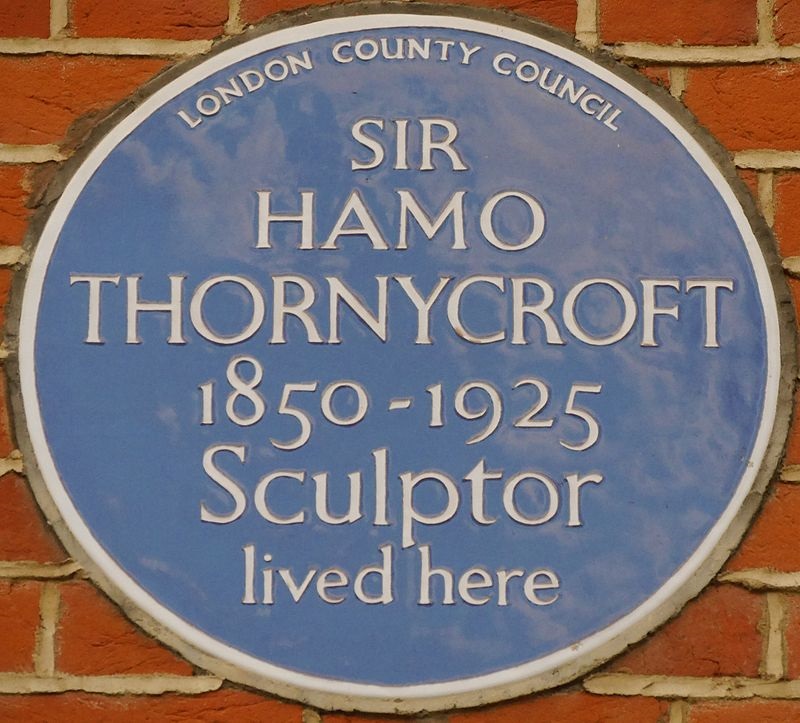
After that sculpture, his work received a considerable reputation, and he got several commissions. He was knighted in 1917. If you walk in Merlbury road in London, you can see the blue plaque which mentions the location of his studio.


Sources
Liverpool Museum
Curator Interview about a sculpture of Thornycroft and the New Sculpture Movement

Leicester Galleries

Glasgow sculpture - Hornycroft Biography
 The Gay Love Letters of Edmund Gosse to Hamo Thornycroft

Wikipedia

Wednesday, June 15, 2016

Icarus (1) Classical sculptures

Since my childhood and the reading of Mythology Tales, followed by classical studies and trips to Greece, Italy and Egypt, I always kept an interest towards mythology.
So today you will see a first post about Icarus & Daedalus sculptures, which will be followed by one or two posts about more recent & contemporary sculptures of them. I will add my version of it as well, done in blue alabaster.

Below is a bas-relief done in the 17th century, with a Cretan labyrinth, visible at the Musée Antoine Vivenel in Compiègne (France).


A short summary of the Legend (re-written/shortened from Wikipedia):

''Icarus' father Deaedalus, a very talented and remarkable Athenian craftsman, built the Labyrinth for King Minos of Crete near his palace at Knossos to imprison the Minotaur, a half-man, half-bull monster born of his wife and the Cretan bull. Minos imprisoned Daedalus himself in the labyrinth because he gave Minos's daughter, Ariadne, a ball of string in order to help Theseus, the enemy of Minos, to survive the Labyrinth and defeat the Minotaur.

Daedalus fashioned two pairs of wings out of wax and feathers for himself and his son. Daedalus tried his wings first, but before trying to escape the island, he warned his son not to fly too close to the sun, nor too close to the sea, but to follow his path of flight. Overcome by the giddiness that flying lent him, Icarus soared into the sky, but in the process he came too close to the sun, which due to the heat melted the wax. Icarus kept flapping his wings but soon realized that he had no feathers left and that he was only flapping his bare arms, and so Icarus fell into the sea in the area which today bears his name, the Icarian sea near Icaria, an island southwest of Samos.''


The fall of Icarus has been sculpted (and painted) numerous times. So I only suggest a very subjective selection of sculptures. Let start with a magnificent white marble sculpture achieved by Paul Ambroise Slodtz (1702-1758), the death of Icarus, displayed in the Louvre museum.


Here is a medallion from the 18th century, showing Icarus fall, the author is unknown. Located in the Louvre Museum collection in Paris. 


Below, the first masterpiece from the sculptor Canova, dated 1779, commissioned by Pisani, procurator of the Venetian republic. This 'group sculpture' in marble shows Icarus' father attaching the wings to his son's arms. This sculpture is visible at the Museo Correr in Venice (Italy).


Not too long after that, the French sculptor Henri Joseph Ruxthiel sculpted the same type of scene, a bas-relief showing Daedalus attaching the wings to Icarus' body. It is located in the Ecole Nationale des Beaux Arts in Paris.

To finish today's post, here is a bronze sculpture from Sir Alfred Gilbert (1854 – 1934), son of professional musicians, who was an English sculptor and also a goldsmith (he was passionate about bronze casting techniques). This is a bronze with a very dark patina, placed on an ebonised wood plinth.


This art piece representing Icarus was commissioned by Frederic Lord Leighton in 1882 after the exhibition of Perseus Arming at the Grosvenor Gallery. Lord Leighton, a painter and a sculptor, was already mentioned in this blog here, and had already painted the subject of Icarus, see below. 

Sources:
Wikipedia
National Gallery of Art
http://lemythedicare.unblog.fr/category/le-mythe-dicare-arts-plastiques/

Wednesday, February 24, 2016

The Sluggard by Lord Frederic Leighton

I guess the title of this sculpture reflects well the month of February 2016 for this blog : only one post published! :) The Sluggard is one of the famous male sculptures made by Lord Frederic Leighton (1830-1896), who was also a painter.
The sculpture represents an athletic young male, awakening or stretching his body. Leighton was inspired to create this bronze because one of his male models – Giuseppe (Gaetana) Valona – stretched himself after he was sitting for a long while posing for one of Lord Leighton painting.
  
The first model of this sculpture was made of gypsum in 1885 and was a life-size sculpture of "The Sluggard" that is nowadays exhibited at the London Tate Gallery'', in bronze. Another version of smaller size (52 cm) was casted in bronze with Laughton's approval and signature. 
Leighton was born at Scarborough, UK, and went early to Florence, Italy, to study. He spent some time in Frankfurt, Germany, and again in Italy, in rome, before going back to UK at the age of 30.
Below photo is a statue of Lord Leighton, located on the façade of the Victoria and Albert Museum. London, near the Brompton Avenue entrance. [Photograph by George P. Landow, December 1999.]

The portrait of Leighton was Brock’s diploma work for the Royal Academy and the cast which he exhibited in 1893 is at Burlington House. Lord Leighton was elected to the Athenæum in 1866.

Photograph courtesy of the Athenæum. Frederic Leighton by Thomas Brock. c. 1892. Bronze. 32 1/2 inches.
 
Two years ago, Stuart Sandford, young British artist, was inspired by the Sluggard sculpture of Leighton and made a contemporary version by photographing a model (Brad) in 3D, making a 3D printed model, later casted in aluminium, marble dust & resin, silver etc. of different sizes.


Sources :
Tate Gallery
Stuart Sandford website
Victorian Web