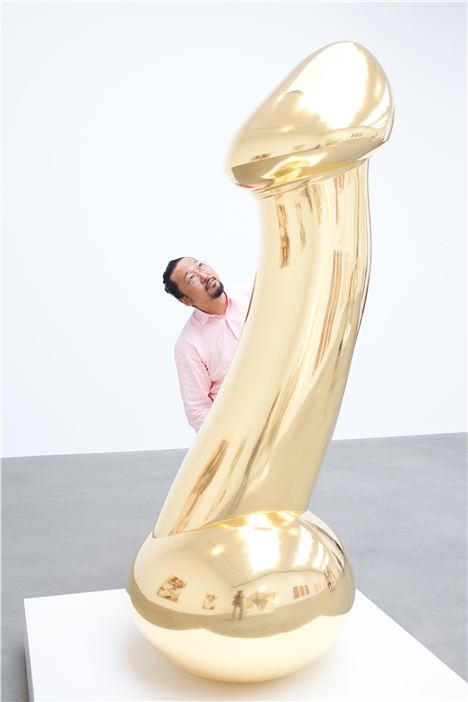
This lonesome cowboy, a geant nude male sculpture of Murakami was certainly a surprise in the Tokyo art gallery where it was displayed, and certainly attracted most of the attention.
Created in 1998, it represents a young man and his sperm in a lasso shape around his body, in a style that we would compare to manga cartoons and pop culture, or also what is now called in Japan as the Otaku culture.
It was made in resin, with oil and acrylic paints, and measures 3 meters high. In addition to Japan, it was also exhibited in London and Los Angeles.
Murakami does not expressively shows gay scenes in his work, but sometimes he creates a homoerotic theme. Like this 'CowBoy' proud to show his sperm or masturbation act. A critic mentioned that it was possibly to show the macho spirit in America, the masculinity, the bond among men.
Takashi Murakami is born in Tokyo in 1962. Wanted to create cartoons. Had a father taxi driver. He succeeded to enter at the Arts University. He founded his own workshop at age 33. Then worked for Louis Vuitton in 2004, creating new colored designs with the famous logo. Had a famous although controversed exhibition in Versailles Palais des Glaces in 2010.
Below are two links for short videos about Murakami. The first one is about the Otaku culture, the next one is at the Brooklyn Museum.of Art, where the 2nd retrospective about the artist took place, after the one in Los Angeles
These two naked men, located in a prominent cemetery in Paris, and sculpted in stone, are a mystery. They were created by Auguste Maillard, famous French sculptor who died in 1944, but we could not find any information about it (except that it was given after his death), unlike others sculptures from him, well documented.
We initially discovered the existence of this sculpture, years ago and not knowing where it was, through the French photographer Paul Marguerite. Then, only knowing the town (which has two cemeteries), looking at the other pictures we determined which of the two it was, and went a few days ago, where we could take the pictures of this post. So it is located in the 'New' cemetery of Neuilly, actually on the areas of Puteaux/Nanterre, built around 1884.
Auguste Maillard was born in 1864, he studied sculpture with Alexandre Falguière, at the Paris Fine Arts school. Numerous busts and monuments from him are disseminated in France. In public places, cemeteries. He died accidentally during the 'Libération' or end of the last war, in August 1944, having received a lost bullet in front of his house, in Neuilly.
During the World Exhibition held in Paris in 1900, he received an award for his 'Icarus fall'
marble sculpture, which unfortunately disappeared mysteriously during a transfer for being 'renovated', in 2005.
Auguste Maillard 'Icarus Fall' postcard - Collection Delcampe
Michel Ange (1465-1564) who had a passion for the male body, and numerous lovers, was commissionned by Pope Julius II to create his tomb. Part of that project, who took in total close to 40 years, are two slave sculptures : the dying slave, and the rebellious slave.
Eventually they were not included in the overall project, and offered by Michel Angelo in 1542 to his friend Roberto Strozzi, who himself, gave them later on to the French King François 1st.
The dying slave is a larger-than-life-size marble sculpture, displayed in Paris in the Louvre Museum, full of sensuality.
And in Paris, even larger sculptures of the Dying slave can be seen! Indeed, at the 80 avenue Daumesnil, which cross the Rambouillet street, 12 copies have been made below the roof, each close to 5 meters high. There is a large triangle cut in the back/chest. The
building was designed by the Spanish architect Manuel Nuñez-Yanowski who started working for Ricardo Bofill.
A contemporary version was made by the French artist Yves Klein (1928-1962).
And a French stamp engraved in 2003 showing both the rebellious slave and the dying slave.
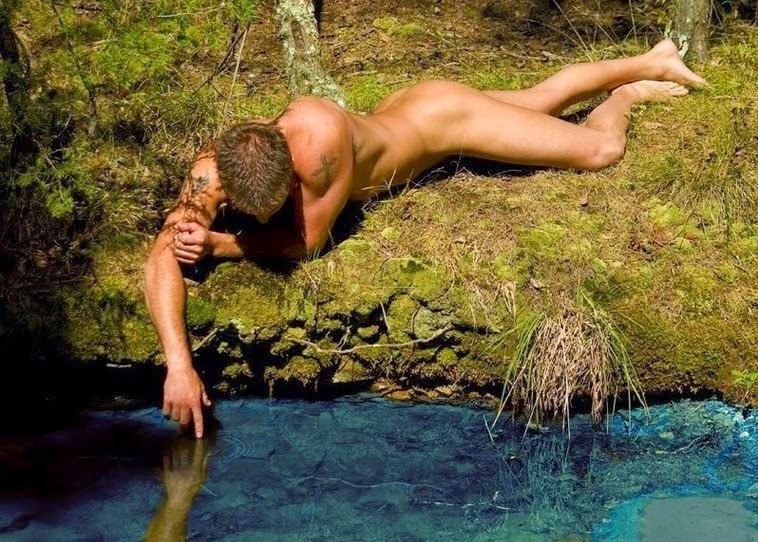
Everyone has heard about this myth, at least one of the many versions. Most of the versions have similar elements, like the extreme beauty of Narcissus, and his death.
The Ovide's Metamorphoses tells the story of Narcissus and Echo, ''a mountain nymph, who saw him, fell deeply in love, and followed him.
Narcissus sensed he was being followed and shouted "Who's there?". Echo
repeated "Who's there?". She eventually revealed her identity and
attempted to embrace him. He stepped away and told her to leave him
alone. She was heartbroken and spent the rest of her life in lonely
glens until nothing but an echo sound remained of her. Nemesis,
the goddess of revenge, learned of this story and decided to punish
Narcissus. She lured him to a pool where he saw his own reflection. He
didn't realize it was only an image and fell in love with it. He
eventually realized that his love could not be addressed and committed
suicide.''''
The male version of it, ie a young man instead of a woman who fells in love with Narcissus, is the one by Conon (who lived at same time as Ovide). ''Aminias indeed fell in love with Narcissus, who
had already spurned his male suitors. Narcissus also spurned him and
gave him a sword. Aminias committed suicide at Narcissus's doorstep. He
had prayed to the gods to give Narcissus a lesson for all the pain he
provoked. Narcissus walked by a pool of water and decided to drink some.
He saw his reflection, became entranced by it, and killed himself
because he could not have his object of desire.''
A few sculptures have been created from this myth. My preferred one is sculpted by Paul Dubois, in 1866 currently displayed at the Orsay Museum in Paris.
Paul Dubois marble sculpture 'Narcissus' 1866 (detail)
Drawing - study- by Paul Dubois for his Narcissus sculpture.
Same sculpture - back
Other sculptures are from Jean-Pierre Cortot, in the Musée des Beaux Arts of Angers, France.
From Ernest Eugène Hiolle (1834-1886) - Fine Arts Museum of Valenciennes, France.
Narcissus by Ernest Eugène Hiolle
From Benvenuto Cellini, displayed at the Bargello, Firenze, Italy.
And below is a curiosity, a hand mirror made by Henri Nock, in 1897, with silver, enamel, precious stones, showing a little sculpture of Narcissus looking into the mirror.
In terms of more recent or contemporary sculptures of Narcissus, here are also two examples.
First by Glyn Warren Philpot (1884-1937), British artist more known for his portraits, elected to the Royal Academy in 1923, but who suffered later during his career while doing controversial art pieces for his time. This work was cast posthumously by the artist's niece.
Glyn Philpot - Echo and Narcissus - Bronze 56cm
And this one, made by Karl-Jean Longuet (1904-1981). He studied in Paris, met Brancusi and visited his workshop in 1949, then started to create more abstract figures like this Narcissus.
Now, if you read French, is a more detailed story that includes many aspects of this myth gathered together. Source : the world history of male love
Au dire de tout le monde Narcisse était le plus beau
garçon de toute la Grèce. Même bébé il attisait les braises de la
passion de toutes les femmes qui le gardaient, les jeunes comme les
vieilles. Avant son seizième anniversaire il était déjà l'objet de
chaque fantasme féminin sur des kilomètres à la ronde et aussi de plus
de quelques fantasmes masculins. Ni les filles ni les garçons ne
l’intéressaient pourtant le moins du monde.
Echo était une nymphe de la montagne qui avait une fois servi Zeus en
entraînant Héra dans des bavardages insensés chaque fois qu’elle était
proche de découvrir que le Dieu de la foudre compromettait les voeux de
son mariage. Le bavardage de Echo donnait aux invitées de Zeus
suffisamment de temps pour faire leur sortie. Quand Héra découvrit le
caprice de déesse loquace, elle éclata de rage "Désormais cette langue
malfaisante sera silencieuse ! Sauf quand on te parlera, tu ne parleras
pas et même alors tu n’émettras que de brefs bruits."
Ainsi quand Echo surprit Narcisse un matin comme le jeune homme luttait
avec un cerf qu’il venait de prendre dans son filet, elle ne put que
regarder sans parler. Et regarder fut ce qu’elle fit. Même parmi les
dieux immortels elle n'avait jamais vu son pareil. Un désir brûlant
courut dans ses veines. Comme elle désirait séduire le beau jeune homme
avec des mots mielleux, mais elle bougeait ses lèvres en vain.
Narcisse sentit ses yeux sur lui. "Qui est là ?" appela-t-il.
-"Là," répondit Echo, qui pouvait seulement répéter ce qui lui était dit.
- "Laissez-moi vous voir" dit le garçon.
- "Vous voir," dit Echo.
-"Vous appelez," répondit la nymphe. Et, incapable de contenir son
ardeur, elle s’échappa de sa cachette et se jeta, chaude et haletante,
sur le bel adolescent. Commençant à être habitué à un tel comportement,
Narcisse se libéra rapidement de son étreinte et s’enfuit en toute hâte
au plus profond de la forêt, laissant ses filets derrière lui.
Echo le poursuivit, essayant de crier les mots qui apaiseraient ses
craintes, le désarmeraient, mais aucun son ne vint. Le jeune homme
disparut bientôt de sa vue. Pendant des semaines la nymphe erra dans la
forêt à la recherche de son bien-aimé, dormant peu, ne mangeant rien.
Elle s’amincissait tant qu’il ne resta bientôt d'elle rien qu’un oeil
puisse discerner. A ce jour elle erre dans les montagnes du monde
entier, cherchant toujours Narcisse. Les canyons rocailleux et les
vallées profondes sont sa demeure. On peut l’appeler, et si elle est là,
elle répondra mais seulement avec les mots qu’on lui aura dits. Par
décret de Héra elle ne peut en prononcer aucun autre.
Un après-midi, à un mois de sa fuite devant Echo, dans un bois isolé
haut sur le mont Hélicon Narcisse tomba à genoux, épuisé de chasser et
d’être chassé. Devant lui se trouvait une pièce d’eau claire et profonde
dont la surface vitreuse capturait la lumière qui traversait les arbres
au-dessus pour devenir un miroir parfait. Ceci, bien sûr, se passait
bien avant que les miroirs comme nous les connaissons aient été
inventés.
Narcisse avait vu son ombre plusieurs fois mais jamais son reflet.
Ainsi, quand il se pencha appuyé sur ses mains et ses genoux et regarda
dans la mare, il fut surpris par l'image de beauté sans égale qui le
regardait. Aucun visage qu’il ait vu ne ressemblait à celui qu’il
étudiait à présent. Pour la première fois de sa vie il tombait amoureux.
Il baissa son visage plus près pour embrasser le jeune homme et tendit
les bras dans la mare pour l’embrasser. Ses lèvres et ses bras
trouvèrent seulement de l’eau. Bien qu'il se retira rapidement, l'effet
de miroir fut un moment détruit par des ondulations dans l'eau. Pensant
que son bien-aimé l’avait fui comme il avait lui-même l’habitude de le
faire, Narcisse se mit à pleurer. Bientôt, cependant, l'eau s’éclaircit,
et le beau visage apparut à nouveau. "Ne me laisse pas, ô beau jeune
homme," supplia-t-il. "Reste, mon amour."
A nouveau Narcisse baissa la main pour toucher la forme dans l'eau ; à
nouveau l'image s’estompa quand sa main cassa la surface. Presque
convaincu qu’il avait cette fois pour toujours perdu son vrai amour, il
s’arracha les cheveux et se griffa la gorge de ses ongles. Quand il se
fut apaisé et que les eaux se furent à nouveau éclaircies, l'image de
son amour réapparut, meurtrie et échevelée. La vue le peina, et il
pleura.
Le chariot d’Hélios finissait sa course à travers le ciel, la nuit grise
envahissait la forêt, mais Narcisse ne bougea pas. Rien ne lui
importait plus que sauver le jeune homme insaisissable dans la mare. La
première lueur de l’aube le trouva à regarder attentivement dans les
claires profondeurs de l’eau. Le visage qui apparu lentement était
hagard et angoissé. Il tendit la main dans l'eau pour caresser cette
joue maintenant si chère à lui, et ses frustrations du jour précédent se
renouvelèrent.
"Je t’aime ! Je t’aime !", cria-t-il un millier de fois dans la mare. Le
visage, comme Echo, bougeait la bouche mais n’émettait aucun son.
Malgré lui, incapable de quitter le bord de la mare, Narcisse finit par
mourir là, sa contenance jadis si belle maintenant tordue et grotesque.
Les nymphes de la montagne le trouvèrent et l'auraient enterré ; mais
comme elles le préparaient pour les funérailles, son corps disparut, et
où il se trouvait éclôt une fleur aux pétales d'or teintés de blanc.
We thought it would be interesting to show a few sculptures from exhibitions focussing on the male nude in art. Todays' sculpture was displayed during the 'Masculin Masculin' exhibition held recently in Paris (Sep 2013 - Feb 2014) at the Orsay Museum. Approximately 20 male nude sculptures were selected by the curator/director Guy Cogeval and his team (together with 180 other art pièces mainly paintings and photographs). The period ranged from 1800 until today.
Among them, for today, I selected 'Mercury Inventing the Caduceus' done by Jean-Antoine-Marie Idrac in 1878. This French sculptor is born in Toulouse in 1849 and died early, in 1884 of typhus. He studied under Alexandre Falguière and also Pierre-Jules Cavelier. He won the famous Prix de Rome in 1873. He also exhibited at the Salon from 1877, and got a first class medal two years later for our selected marble sculpture.
This large marble piece was sculpted in Rome, Italy, in 1878. Several years later, in 1886, a copy in bronze was casted, which was displayed at the Exposition Universelle (World Fair) of 1900 in Paris(and today in Toulouse, at the Musée des Augustins).
One of the other curators of the 'Masculin Masculin' exhibition, Xavier Rey, stated that male nude anatomy and study was extremely important for every artist training. With some humour trait, Guy Cogeval added that this sculpture shows probably the cutest buttocks of the museum!
Indeed, several of this exhibition's sculptures and paintings contain a clear homoerotic aspect. And part of the exhibition is specially focussed on the male as an object of desire.
Why ' inventing the Caduceus ' ? The mythology has many stories about this! One reports that Mercury wanted to find a symbol for his role as the god of healing and messenger of the gods. He received a gold stick from Apollon. Later on, seeing two snakes fighting, he throw his gold stick towards them, the snakes curled around the stick and stopped fighting.
The serpent-coiled staff, or caduceus, is sometimes illustrated with wings at the top end to match Mercury’s winged helmet.
To close this chapter on the art représentations of St Sébastien as a gay icon, here are a few more contemporary sculptures, ie after the Renaissance period.
Alexandre Louis Charpentier (French) late 19th century, Bronze. Metropolitan Museum NYC, USA.
Damien Hirst, British artist, created his work entitled 'St Sébastien - Exquisite pain' in 2007. Here is the Damien Hirst website.
Damien Hirst
Marcel Julius Joosen, Dutch artist already mentioned on this blog, and born in 1943, he did this first plaster sculpture in 1992.
And the following one.
Marcel Julius Joosen
The next two sculptures are from Marc Alberghina, French contemporary artist, who spends lots of time fighting against mass art production with cheap material or clay and poorly done.
St Sébastian 1 - 2012 - Enameled faience
St Sébastian 2 - 2012 - Enameled faience
Michael Richards (Art Gallery of Ontario, Toronto, Canada)
Italian family near Lucca, Italy (Catholic Store)
Steven Beyer
Thierry Delorme
Misztal Tomasz
David Pelletier - Bronze - 2002
_________________________________________________________________ Sources and more info:
A stunning collection of contemporary representations in these 2 blogs: