Wednesday, May 13, 2015

The african male by sculptor James Richmond Barthé

Another example of African-American artist who expressed some homo eroticism at least in some part of his work is James Richmond Barthé.


He was certainly not openly gay (born in 1909), but when he arrived in Harlem aged 20, he soon got several gay friends, who persuaded him to express gay love or male beauty in his art. which he did for 10 years. Indeed he sculpted several African-American men, nude, or in sensual attitudes.
But expressing it, may have been an obstacle at that time to pursue a great career as artist.


Below are some extracts of his interesting biography published in Advocate.

''Barthé was born to Creole parents in Bay St. Louis, Miss., and his art brought him out of poverty. A beautiful, bright boy, he was already winning awards for his drawings by the age of 12. Inspired by the neoclassical art he saw in the homes of the wealthy folks he worked for as a houseboy in New Orleans, he developed a lifelong interest in Greek and Roman mythology.''


''Funded by his local church, he attended school at the Art Institute of Chicago and began to have adult affairs with men who sometimes became patrons. He also had a brief affair with author and actor Richard Bruce Nugent, who was a cast member in Dubose Heyward's play Porgy.''


''In 1930 he relocated to New York and attended A’Leila Walker’s “Dark Tower” gatherings, known as a venue where black and white men and women, often gay, mingled. The photographer and writer Carl Van Vechten was deeply involved with the black community of New York in the '30s and was an ardent supporter of Barthé's work. His reputation grew and his work was included in a 1935 exhibit of African-American art at the Museum of Modern Art.''

''He had success and fame. He even had a female patron who set up a trust for him that gave him the freedom to work without financial worries. But he was still an outsider in many ways. He was not a part of the white art world, and his uncompromising homosexuality kept him distanced somewhat from other artists of the Harlem Renaissance. His love life was a series of short affairs that never developed further.''

''In 1975 he moved to Pasadena, Calif., and a year later curators at the Los Angeles County Museum of Art included his work in “Two Centuries of Black American Art.” The attention to his work, the growing respect of a younger audience to artists of the Harlem Renaissance, and the support of his friends brought Barthé stability once again. He lived out his later years as a treasured part of the art community, dying in Pasadena March 6, 1989. ''

Barthe, maybe because he could not attend a New Orleans art school as a teenager because he was black, (and hence went to an art school in Chicago), and also with his Mississipi background, admired the figure of Toussaint Louverture, abolishing slavery in Haiti in 1801. He made several sculptures about him. Below is a picture of the largest one, 40 feet high, which was to be erected on the Champ de Mars facing the National Palace in Haiti capital, Port au Prince.


The Awakening of Africa, whose picture starts this post, was made in bronze in 1959 and is one of Barthé chefs d'oeuvre. You can see another angle of that sculpture on the cover of Sculpture Review magazine (Spring 2011 edition). That edition is focussed on African American Sculpture and key African American figurative sculptors. 


One of the article in that edition (Young, Gifted, and Black Between the Wars - Richmond Barthé’s Manhattan Years) was written by Margaret Rose Vendryes.  She also wrote the book ''Barthé : A life in scupture''.  Indeed during 20 years she was close to the artist, from when he just arrived in New York / Harlem until 20 years later.

Wednesday, April 29, 2015

A few male sculptures from the Paris Opera Garnier (3) Louis Felix Chabaud

The largest serie of sculptures from the Opera House is from the French sculptor Louis Felix Chabaud (1824-1902). It is an impressive collection of more than 400 art pieces that have been recorded so far, from busts, masks, statues, both inside and outside.


The recent book of Jean-Marc Hery 'Louis Felix Chabaud, un sculpteur oublié'  (A forgotten sculptor) allows us to re-discover this.
From modest farmer origins, he started to work on stones aged 15, in Aix en Provence, then studied sculpture in the same town, before moving to Paris. At 24, he won the Prix de Rome for the engraved medals category, so he can go to the famous Villa Medicis, where he will meet Charles Garnier, another winner. Chabaud had a strong relationship with the architect Garnier, and started to receive commissions for the Opera House. It is the beginning of some impressive work.

For example the carved Opera zodiac vault (with 16 heads : 12 zodiac signs and the 4 cardinal points), the golden busts representing famous composers, some lighting busts, and of course the numerous (275) masks, and the giant marble head of Minerve (5 meters high).

'Poissons' zodiac sign - Chabaud


'Comédie' by Chabaud
'Tragédie' by Chabaud

A selection of videos to visit the Opera House:
Official website
Inside visit of the opera 
About the architecture


Other sources about the sculptor Louis Felix Chabaud:
Comprehensive general website about him, in French
Book about him by Jean-Marc Hery

Wednesday, April 15, 2015

A few male sculptures from the Paris Opera Garnier (2) Jean-Baptiste Carpeaux


This 'Spirit of Dance', a smiling young man playing music is part of the large sculpture from the main side of Opera Garnier in Paris, called 'La Danse' (The Dance), executed by Jean-Baptiste Carpeaux (1827-1875).

It took a few years to agree on the final sculpture between the architect (Charles Garnier) and the sculptor, and to achieve it. The final result still caused much controversy due to the females nudity involved. A bottle of ink was even thrown on it one day. Some wanted the sculpture to be removed. But the war of 1870 started, and the sculptor died as well, so this put an end to the controversy.

La Danse, 1866, by Jean-Baptiste Carpeaux (Opera Garnier) - photo Verchere
Nowadays, the original piece is located at the Musée d'Orsay to ensure its protection from the weather, and a copy is in front of the Opera House, copy made by the French sculptor Jean Juge, and supervised by Paul Belmondo, other French sculptor.
 
Have a look at this interesting video about 'La Danse'

We may come back to some other Carpeaux sculptures. The Musée d'Orsay organized a major exhibition last year about his work.


Sources:
Musée d'Orsay
Video
Wikiphydias


Wednesday, April 1, 2015

Oreste, muscular young naked hero, by Pierre-Charles Simart

Pierre-Charles Simart is another French sculptor (1806-1857), born in Troyes, who moved to Paris at the age of 17, thanks to a scholarship. He won a Prix de Rome 9 years later.

Back from Rome, he sculpted major pieces in Paris such as a Napoleon statue, and several for the Louvres (Sully pavillion, Denon pavillion, ...). Among his teachers, lets name Ingres.
Simart himself also teached at the Ecole des Beaux-Arts.

The bronze sculpture below, in Troyes, is from the mythology story of Oreste, searching help from Pallas.


The same sculpture was sculpted in marble and is located in Rouen (below).


Oreste - marble statue - detail
  Below is an old drawing made by the French painter Paul Flandrin (1811-1902) who, like the sculptor Simart, had the same teacher (Ingres).
Drawing from Paul Flandrin (1811-1902).
 And a contemporary version was made by Pierre & Gilles, with their painted photography of Oreste in 2013, displayed at the Galerie Daniel Templon (Paris). The model was Staiv Gentis.
Oreste, by Pierre & Gilles, 2013.
Sources:

Wednesday, March 18, 2015

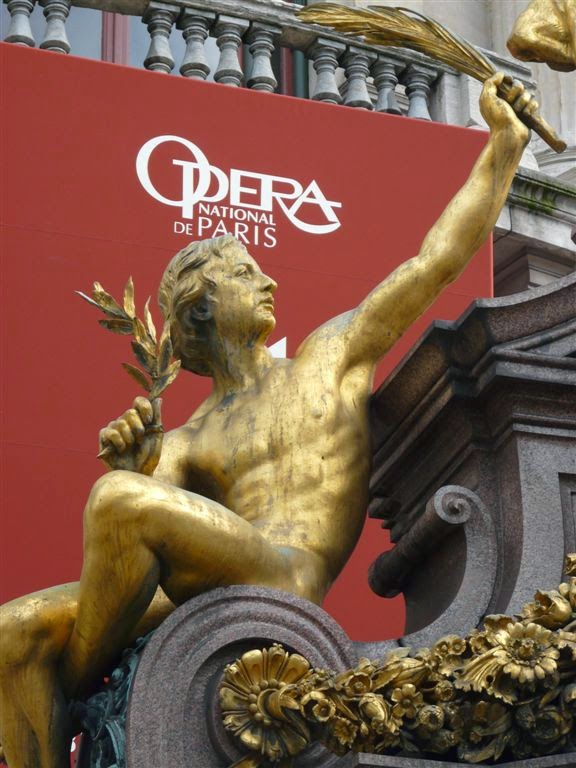
A few male sculptures from the Paris Opera Garnier (1) Gabriel Jules Thomas

The beautiful Opera Garnier in Paris gives us the opportunity to share a few sculptures from both the inside and outside of this outstanding building, among the hundreds available. You can visit this Opera House in detail, and in person, or even online ! Check this Opera Garnier website link.
Today, lets have a look at some outside sculptures from Gabriel Jules Thomas (1824-1905), who was a French sculptor, winner of the Prix de Rome.
A more detailed (French) biography by Nella Buscot can be seen here.

His 'La Renommée et l'Etude' bronze sculpture was made in 1903, to honor the architect Charles Garnier. Located on the West side, previously the entrance of the Chief of State, it is today the visitor's entrance.
'L'Etude et la Renommée' by GJ Thomas (detail - here 'L'Etude')

West side of Opera Garnier - 'L'Etude et la Renommée' sculpture - photo cergyrama

 (The bust of Charles Garnier above the two naked men was sculpted by Jean-Baptiste Carpeaux).
'L'Etude'

La Renommée (detail)

Wednesday, March 4, 2015

Rising young man by Despiau

Thanks to a blog reader from Canada, I am sharing with you this French sculptor, Charles Despiau (November 4, 1874 – October 30, 1946).
Despiau worked for Rodin as an assistant in 1907, and did some personal sculptures also, taking his time for each of them, therefore not focussing at all on the quantity of sculptures he would do (150 known in total during 50 years of sculpting). 

Despiau did mostly portraits, and nude, as the one I choose to display here, the 'Rising Young Man'.

His one-man show of 1927 in New York, when he was 51, gave him a larger notoriety and success, resulting today in sculptures present among 30 museums in France, and 100 in the world. In New York, he has works in the MET and also the MOMA.

He died  in Paris.

Despiau - Rising young man -
See also this Charles Despiau video
You can visit the museum (Tour Lacataye) organized around his work in Mont de Marsan, France
 

And some statues are also displayed in Luxembourg, at the Chateau (and garden) of Colpach.

Sources :
Site Chateau de Colpac / Croix rouge

Charles Despiau website

Wednesday, February 11, 2015

Male couple sculpture in Ancient Egypt (1)

For the coming St Valentine day, I suggest today the story of possibly the first male couple sculpture  in the history!

'Khnumhotep and Niankhkhnum were two ancient royal servants who shared the title of “Overseer of the Manicurists in the Palace of King Niuserre.” 

On their tomb, these two men are sculpted in a very intimate pose, reportedly the one allowed by Egyptian artistic conventions: face to face, with their noses touching. 

Niankhkhnum means “joined to life” and Khnumhotep means “joined to the blessed state of the dead;” together their names mean “joined in life and death.” 

Some archeologists describe them as the first same-sex couple in recorded history. The picture below shows a detail from their tomb dating to around 2350 BC.  '

Below is the stone engraving or 'bas-relief' of this couple.


Sources :
Wikipedia, and a very interesting article from the New York times, here :  nytimes

Painting inspired by this couple - Artist unknown

Wednesday, January 21, 2015

Sensual males sculptures in cemeteries (2)

The Rome cemetery of Campo Verano contains an other male sculpture of interest.
The engraving below seems to indicate, although unclear, 'ARI ALLINI Roma 1875'.

Photo by Marco

Photo by William McClung

Photo by William Mc Clung

Wednesday, January 14, 2015

Thinking, reflecting, meditating ?

The sculpture below, for which I havent succeeded yet to find the author or location, seems relevant to start this new year.

The nude young man seems to think, maybe meditating. If in a cemetery, maybe silently still loving his partner.


Sunday, January 11, 2015

Paris January 2015 - Stone sculpture looking for Liberté Egalité Fraternité...

Immortality of this stone male sculpture...
Eiffel tower symbolizing Paris...
Paris symbolizing France,
France symbolizing Freedom, 
Freedom of Expression, Democracy, 
Liberty, Equality, Fraternity, ...


Photo Julien Fourniol - 2010

The sculpture is looking towards the Tour Eiffel from the 'Esplanade des Droits de l'Homme' (Human Rights place) and Palais de Chaillot.
 
After the recent events of Paris, I want to interpret this statue as looking at this dream of people living peacefully together, and working together to elevate the human spirit.